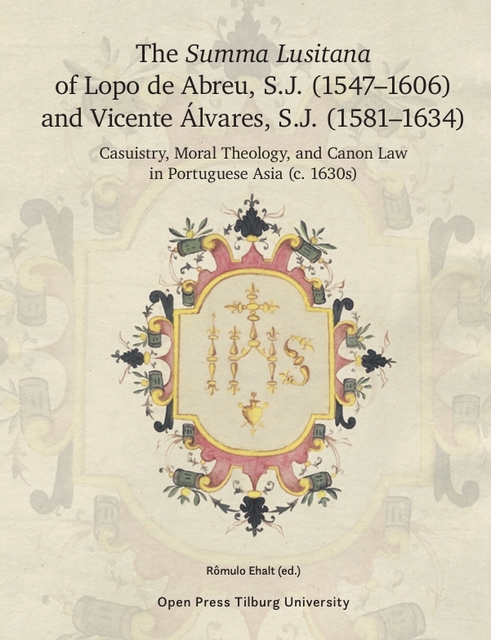
The Summa Lusitana of Lopo de Abreu, S.J. (1547-1606) and Vicente Álvares, S.J. (1581-1634)
Casuistry, Moral Theology, and Canon Law in Portuguese Asia (c. 1630s)
by Lopo de AbreuRômulo Ehalt (Ed.)
"Originating in the 1630s as a Latin translation of Lopo de Abreu’s lost Portuguese manuscript, Suma de Moral (1603), the Summa Lusitana is one of the most significant theological and legal manuals to emerge from the seventeenth-century Portuguese empire. Having survived centuries of transcontinental transit, institutional disruption, and successive imperial and European conflicts, the unique extant copy preserved in the Tilburg University Library offers an invaluable window into how Jesuit missionaries applied moral theology, canon law, and casuistry to the complex cultural realities of the Portuguese Padroado.
The work demonstrates a highly specialized, original tradition of casuistic reasoning tailored specifically to Iberian Asia. Moving beyond abstract speculation, the text examines the complexities of global trade networks—including contract law, restitution, and usury—alongside colonial governance, outlining the moral and civic duties of judges, customshouse tax collectors, merchants, mechanical laborers, and the captains of fortresses and voyages. Jointly published by the Max Planck Institute for Legal History and Legal Theory (Frankfurt) and Tilburg University, this foundational source is now available as an Open Access e-book. Future digital iterations will incorporate transcriptions, full English translations, and collaborative critical studies to advance the study of colonial intellectual history."
Recent Activity
Project Kickoff
A Manifold at the Open Press Tilburg University project is born!
Metadata
rights holder
2026 Rômulo Ehalt, for the introduction, notes, and table of contents. The original work reproduced in this volume is in the public domain (Public Domain Mark 1.0 Universal). No copyright is claimed in the facsimile reproduction itself. The facsimile has been produced from a copy held in the collections of Tilburg University Library
We use cookies to analyze our traffic. Please decide if you are willing to accept cookies from our website. You can change this setting anytime in Privacy Settings.